

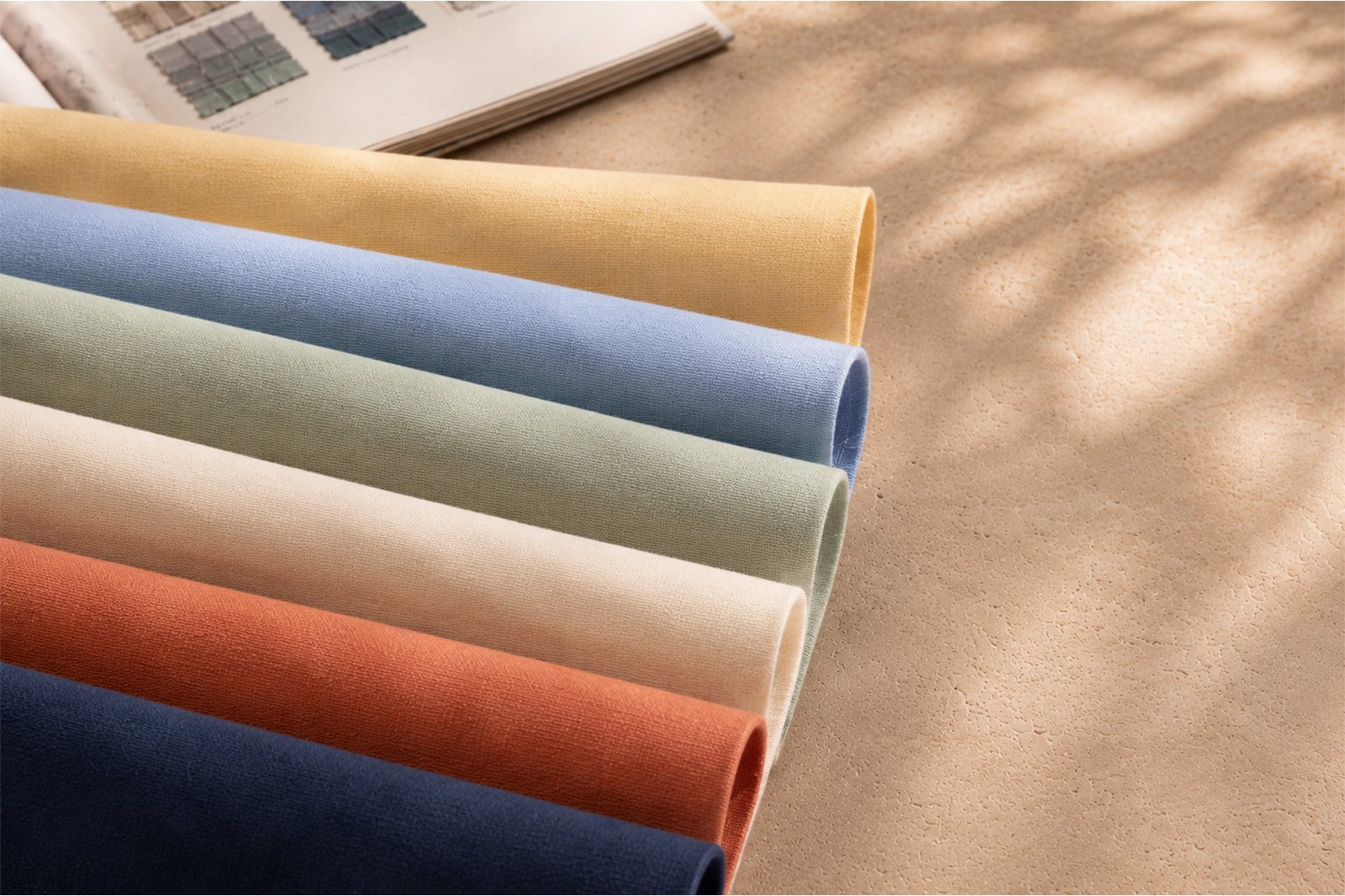
By the time a colour is everywhere, the decision to make it was taken a long while ago. The shade filling a shop window in March was committed to a dye lot the previous summer, chosen from a card by someone who had to believe in it before there was any evidence.
This is the quiet condition of fabric buying. It is an act of anticipation carried out with money. Colour trends shape what a mill weaves, what a supplier stocks and what a brand is able to offer, yet they arrive on a timetable that rarely matches the one a buyer works to. Understanding that gap is where the intelligent purchase of shirting fabric begins.
The Long Arithmetic of a Season
A colour seldom originates in fashion. It surfaces first in interiors, in film, in the walls of a hotel that photographs well. Forecasting houses gather these signals and publish them roughly two years ahead. Mills read the forecasts, yarn is dyed and looms are booked.
For yarn dyed shirting, this sequence is unforgiving. Colour is fixed at the yarn stage, before a single pick is woven. A stripe or a check cannot be reconsidered halfway through production.
The buyer, then, is not selecting a colour. The buyer is selecting a moment.
Two Registers of Colour
Every functioning collection speaks in two registers at once.
The first is permanent. White, sky blue, ecru, pale grey, navy. These shades sell in every market and every season, in volumes that make the rest of the range possible. They are wardrobe infrastructure. A customer replacing a worn white shirt has not consulted a trend report.
The second register is seasonal. Sage, terracotta, butter yellow, oxblood, powder pink. These carry the mood of the year and give a collection its reason to exist. They also carry its risk.
The error made most often in fabric buying is applying the same discipline to both. The permanent register rewards depth of stock. The seasonal register rewards restraint and speed.
Where a Trend Quietly Arrives
A colour trend rarely enters shirting as a bold solid. It enters obliquely.
It appears as the ground of a stripe, where a fashionable shade is tempered by white. It appears as an overcheck on a classic base, occupying a fraction of the surface and supplying all of the character. It appears in a melange, spun through a neutral so that it reads as texture from across a room.
This is where experienced buyers place their conviction. The garment feels current without asking the wearer to commit to a colour outright. The trend is present, but it is worn lightly.
How Cloth Answers a Colour
A shade is not a fixed quantity. It behaves according to the surface on which it is laid.
A poplin holds colour flat and true, which is why it remains the reference for a clean corporate palette. A twill deepens the same shade, its diagonal catching light unevenly. A satin lifts it, introducing a lustre that can carry a soft tone towards formality.
Fibre is equally decisive. Extra long staple cotton absorbs dye evenly along its length, which gives solids their depth and patterns their definition. Egyptian cotton fabric and Supima constructions are chosen for precisely this reason. Shorter fibre scatters the same dye and returns it dulled.
The Price of Conviction
Colour carries the sharpest inventory risk in the whole of fabric buying. A construction can be sold across several seasons. A weight can be repositioned. A shade that has passed cannot be rescued, only marked down.
There is a second cost, discussed far less often. A colour that succeeds will be reordered, and a repeat delivery arriving half a tone away from the original cannot be placed beside the first. In that instance, the trend was never the risk. The consistency of the mill was.
This is why seasonal fabric colours are best taken from stock that has already been dyed, inspected and shelved, rather than from a promise of future production.
Reading the Signal Without Chasing It
The most composed buyers observe rather than react.
They watch adjacent categories, since knitwear and interiors adopt a colour well ahead of shirting. They take short lengths of a new shade before committing a range to it. They pay close attention to what their own customers ask for and fail to find, the most honest indicator available.
And they hold their core in depth, so that a season’s experiment is never funded by an absence of the basics.
An Invitation to Look Closely
At Cirocco, this two-register thinking is built into the way the collection is held. More than a thousand designs in whites, solids, structures, stripes and checks remain available throughout the year, so the permanent register is never in question. Alongside them, over two hundred new designs are introduced each month, developed from continuing research into colour direction, finishes and weave.
With over ninety years in shirting, we work in cotton shirting fabric and Egyptian and Supima constructions, pre-shrunk and colour fast, with ready goods dispatched within 48 to 72 hours. It is an approach that allows a brand to follow a palette without being exposed by it.
Should you wish to see how the coming season’s colour direction has been interpreted in cloth, our fabric specialists would be glad to take you through the current range.
FAQ
How far in advance are fabric colours decided?
Forecasting houses publish colour direction around two years ahead. Mills dye yarn and book looms well before a season starts. By the time a shade appears in shops, it was chosen many months earlier.
Which shirt fabric colours sell throughout the year?
White, sky blue, ecru, pale grey and navy. These are replacement purchases rather than fashion purchases, so demand stays steady in every season. Most collections keep them in stock all year and buy trend shades in smaller quantities.
Why does the same colour look different in a repeat order?
Because it came from a different dye batch. Even a small shift in shade shows up when the two deliveries are placed side by side. Buying from ready stock, or asking your supplier how batches are matched, avoids the problem.
How much of a collection should be trend colours?
Usually a small share. Keep the core shades in depth, then add seasonal colours in short lengths to test them. That way, a colour that does not sell costs very little.