

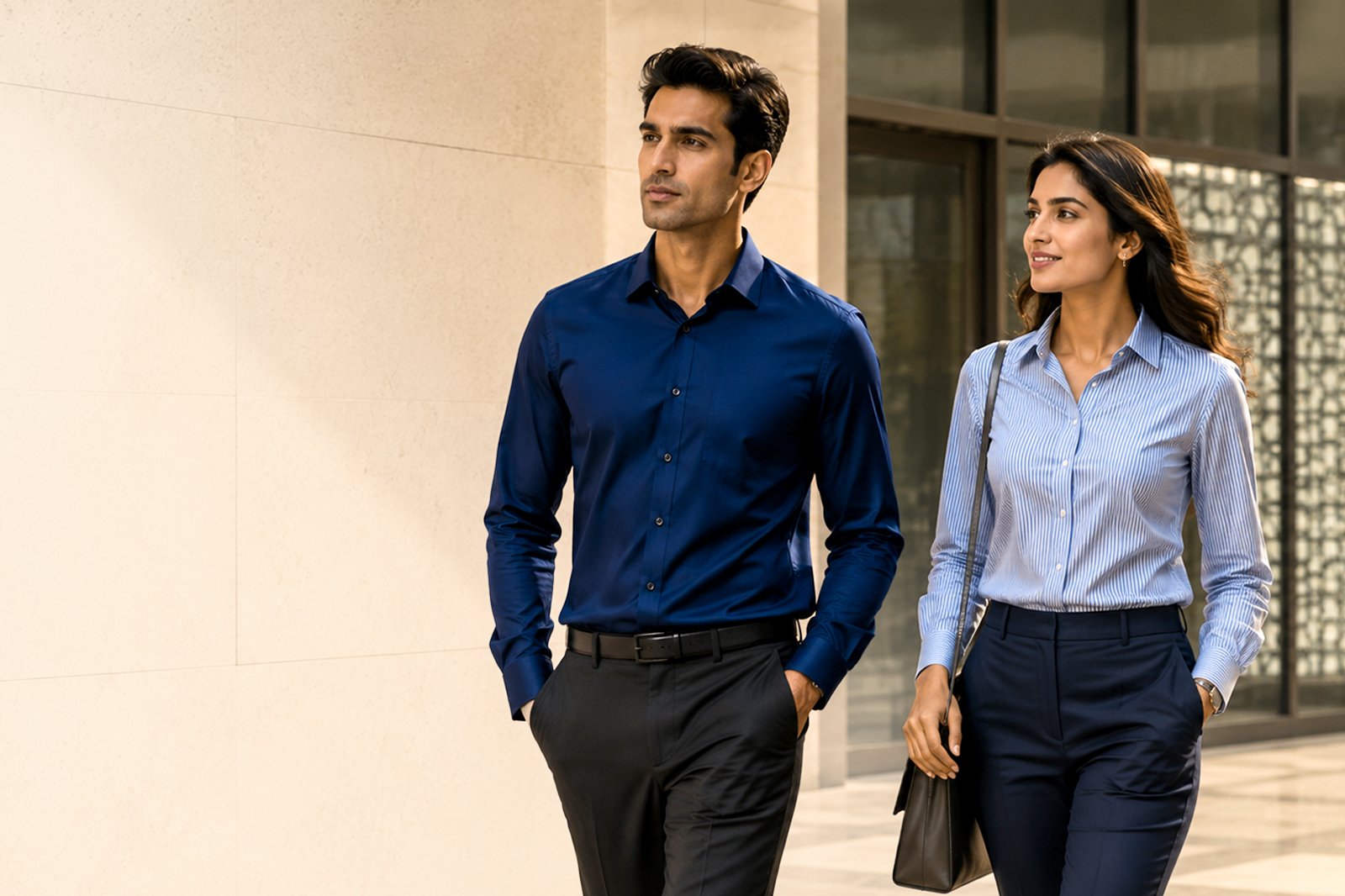
Walk into almost any office and you’ll likely spot at least one blue shirt. It may be a pale blue Oxford worn with navy trousers, a crisp sky-blue shirt under a suit, an oversized linen shirt styled with tailored separates or a deeper blue blouse worn with formal trousers. The silhouettes keep changing, yet blue continues to hold its place in professional wardrobes.
For a brand, a designer or a garment manufacturer, that longevity is commercially useful. Blue sits comfortably between formality and ease. It works across industries, age groups, genders and dress codes. The colour also allows fabric, weave and construction to change the personality of the garment without making it difficult to wear.
At Cirocco Fabrics, that makes blue shirting a useful case study in how colour and fabric work together. A single colour family can move from traditional corporate wear to contemporary semi-formal wear through the choice of fibre, weave and finish alone.
The Long History Of Blue In Clothing
Blue has been part of clothing traditions for centuries, long before corporate wardrobes took shape. One of its most important historical sources was indigo and India had a particularly significant relationship with the dye. Indigo cultivation, dyeing and textile production formed part of the country’s textile history for centuries and Indian blue textiles travelled widely through international trade. The English word “indigo” can be traced to terms referring to India, which reflects how strongly the colour became associated with Indian dye production.
Early blue clothing carried a very different social context from the polished shirts we associate with offices today. Indigo-dyed cotton was widely used in practical clothing because the colour held well on durable textiles. Across different cultures, shades of blue gradually appeared in work garments, uniforms, everyday clothing and eventually more structured forms of dress.
As manufacturing developed and dyes became easier to reproduce consistently, blue became accessible across clothing categories. By the time the modern business wardrobe began to take shape, blue already carried something valuable: familiarity.
How Blue Entered The Professional Wardrobe
The traditional business wardrobe was built around restrained colours and strict dress codes and white shirts became strongly associated with formal professional dressing. Blue earned its place gradually, as ready-to-wear shirting scaled up and pale shades became reliable to produce at volume. Pale and medium blues paired naturally with grey, charcoal, navy, beige and black tailoring, which gave the colour a role in conservative workplaces without the maintenance that white demands.
Offices then became less rigid about what professional dressing had to look like. Suits became optional in many industries. Separates became common. Business casual entered the vocabulary of workplace fashion.
Blue shirting adapted to each shift. A fine blue poplin works under a formal suit. An Oxford-style cotton shirt works with chinos. A linen shirt sits comfortably within a relaxed Friday wardrobe. The same colour moves across several levels of formality without looking out of place and that adaptability has kept it relevant as corporate fashion changed around it.
The Fabric Decides The Shirt
Colour attracts attention first, but the shirting fabric decides how the garment behaves. Take three shirts in almost the same shade of blue and produce them in poplin cotton, textured linen and a high-count two-ply cotton. They will look and feel entirely different once cut and sewn.
Blue also holds an unusually wide range of shades. Powder blue creates a light, clean appearance. Sky blue has become a corporate classic. Steel blue brings depth. Navy moves towards evening and highly structured dressing. Muted blues read as contemporary, while brighter shades support fashion-led collections. That range gives designers and corporate clothing brands considerable room to work within a single colour story.
Cotton For Everyday Corporate Shirts
Cotton remains one of the most dependable fibres for shirting because it combines comfort, breathability and versatility. A blue cotton shirt can be adapted to almost any professional environment depending on yarn count, weave and finish.
Poplin gives a clean, smooth surface suited to formal shirts. Twill introduces a subtle diagonal texture and a softer handle. Oxford constructions create a relaxed appearance for business casual dressing. Jacquards allow the blue surface itself to carry pattern and texture.
Yarn count is where the category separates. Counts around 2/80s and 2/100s serve everyday corporate shirting and hold up to regular laundering. From 2/120s upwards, the yarn becomes finer and the fabric surface cleaner, which is the range most premium formal shirting sits in. Egyptian cotton and Supima cotton take blue shirting further again, since their longer staple allows smoother, finer yarns and better definition in the weave. Blue is particularly effective at these counts because the depth of the shade keeps the quality of the finish visible.
Linen And Cotton Linen For Relaxed Professional Dressing
The modern workplace has also created space for softer tailoring and this is where linen becomes useful. A blue linen shirt carries natural surface texture, drapes casually and allows excellent airflow. For Indian weather, those qualities have practical value. Lighter linen blues work with beige trousers, tailored chinos and coordinated separates, while darker linen blues move easily into evening events and smart casual settings.
Cotton linen blends offer another direction. Cotton contributes softness and stability, linen adds texture and breathability and the resulting fabric suits brands that want a relaxed appearance with enough structure for professional clothing.
Texture, Pattern And Finish
Blue responds noticeably to construction. A plain weave reflects light differently from a satin. Twill gives the surface depth. Melange yarns create subtle variation. Jacquards allow pattern to emerge through weave rather than print.
Scale governs formality in checks and stripes. Fine blue stripes at around 1mm to 2mm remain highly formal. Broader stripes read as casual. Blue and white checks move between office wear and weekend dressing depending on their size and construction.
Finishes matter just as much. Non-iron treatments make blue corporate shirts easier to maintain. Stretch constructions support movement across long working days. Performance finishes help brands develop shirts for people whose routines include travel and extended wear. A blue shirt sounds like a simple product brief, yet there are hundreds of ways to interpret it.
Blue Shirting In Womenswear
The corporate blue shirt is often pictured as a classic men’s button-down, but professional wardrobes have expanded well beyond that image. In womenswear, blue shirting appears across fitted shirts, oversized silhouettes, blouses, tunic-inspired forms, shirt dresses and coordinated sets.
Each silhouette asks something different of the fabric. Crisp cotton poplin supports structured collars and defined cuffs. Softer constructions create fluidity in oversized shirts. Linen suits relaxed tailoring and warm-weather dressing. Finer cottons provide the polish required for premium women’s formal wear.
Designers can also approach the colour differently. A pale blue oversized shirt with wide-leg trousers creates a contemporary office silhouette. A deeper blue blouse works with a skirt or tailored suit. Fine stripes, dobby textures and subtle jacquards introduce visual interest while keeping the garment appropriate for professional settings. The strength of blue lies in this flexibility. It adapts to the garment rather than limiting it.
Shade Consistency Across Repeat Orders
Blue creates one technical demand that few other colour families make so plainly. A brand that reorders a sky blue in January and again in June needs the same sky blue both times. Blues are sensitive to dye lot variation and the shift between two batches becomes obvious when garments hang side by side in a store or when a corporate order is delivered in phases.
This is a sourcing question rather than a design question and it deserves attention early. Ask how a shade is matched, how it is recorded and whether the fabric will still be available when the range repeats. A core blue held as a stock line removes most of that risk. Our Never-Out-of-Stock range exists for this reason and it is one of the reasons brands keep their core blues with us across seasons.
Selecting Blue Shirting For A Collection
For designers and garment manufacturers, fabric selection should begin with the intended garment rather than the colour. Consider where the shirt will be worn. A corporate uniform requires durability, colour consistency and easy maintenance. A luxury formal shirt places emphasis on fibre quality, yarn count and finish. A relaxed women’s shirt requires softer drape. A summer collection benefits from linen or cotton-linen construction. The shade of blue should then meet those requirements.
Familiarity is what makes the colour commercially efficient. Customers already understand a blue shirt and know how it fits into a wardrobe, which allows a brand to experiment with fibre, texture, weave and silhouette from an accessible starting point. A single collection might carry a crisp sky-blue poplin for conventional office dressing, a high-count Egyptian cotton for the premium customer, a striped cotton for everyday corporate use and a blue linen option for relaxed dressing. Each garment serves a different purpose while belonging to the same colour story.
Core blues also stay relevant across more seasons than trend-led shades, which gives them a dependable place within a balanced shirting collection. Fibre, weave, weight, finish and shade together decide how successful the shirt feels once it is cut and sewn. That is one of the lessons decades of working with shirting fabrics has taught us at Cirocco Fabrics. Good fabric sourcing begins with understanding the finished garment.
Build Your Next Shirting Collection With Cirocco Fabrics
At Cirocco Fabrics, more than 90 years in textiles has taught us that the right shirt begins long before cutting and stitching. It begins with the fibre, construction, finish and shade you choose.
Our shirting range covers superfine cottons, Egyptian and Supima cotton, linen, cotton-linen blends, jacquards, performance fabrics and a wide selection of classic and contemporary designs. With over 3,000 ready designs, new collections introduced regularly and an extensive Never-Out-of-Stock range, we help brands, designers, retailers and garment manufacturers source with greater confidence.
Looking for the right blue for your next collection? Speak to the Cirocco Fabrics team to explore shirting fabrics, request samples or develop a fabric specifically for your range.
FAQ
1. Which shade of blue works best under a dark suit?
Pale and mid blues. Powder, sky and soft French blue hold their own against charcoal and navy without competing with the jacket. Deeper blues read as a tonal outfit rather than a contrast. As a rule, the darker the suiting, the lighter the shirt should sit.
2. How well does blue shirting hold its colour after repeated washing?
That depends on how the fabric was coloured. Yarn-dyed blues are dyed before weaving, so the colour runs through the yarn and holds up across long wash cycles. Piece-dyed fabric is coloured after weaving, which costs less but leaves the shade closer to the surface. Ask for colour fastness grades, scored 1 to 5. Grade 4 or above on washing and rubbing is the commercial expectation for corporate shirting.
3. What fabric weight suits a corporate blue shirt?
Most shirting sits between 100 and 160 gsm. Poplin runs around 110 to 130 gsm and Oxford sits heavier at 130 to 160 gsm. Below 100 gsm, pale blues start to show what is underneath them.
4. Why do fine blue stripes sometimes look strange on video calls?
This is moiré. A fine repeating pattern interferes with the pixel grid of a webcam sensor and the stripes appear to shimmer on screen. Stripes under 2mm are the usual culprits. For ranges aimed at people who spend the day on calls, solids, dobby textures and stripes above 3mm are safer choices.